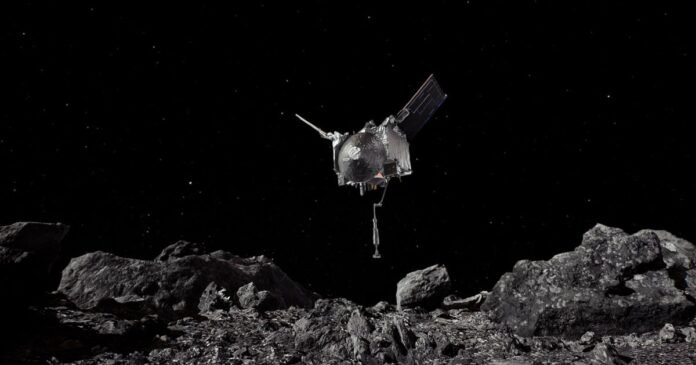
Samples taken from the asteroid Bennu are continuing to shed light on the origins of the solar system.
Scientists have been studying the samples since NASA’s Osiris-REx spacecraft carried them back to Earth in 2020 and recently discovered that that they contain sugars and “a gum-like substance not seen before in astromaterials,” NASA said.
The revelations — and how they can help answer big questions about the beginnings of life — are described in three new papers published Tuesday by the journals Nature Geosciences and Nature Astronomy.
NASA/Goddard/University of Arizona
In the first paper, scientists led by Yoshihiro Furukawa of Japan’s Tohoku University focus on sugars uncovered in the asteroid samples, which are characterized as essential building blocks for biology on Earth. The second, by Scott Sandford at NASA’s Ames Research Center and Zack Gainsforth of the University of California at Berkeley, reveals that the ancient “space gum” also present in the samples could have played a foundational role in catalyzing early life on our planet.
The third paper, led by Ann Nguyen of NASA’s Johnson Space Center, analyzed dust from two different types of rock that Osiris-REx collected from Bennu, which initially came from stars that predate the solar system.
Ingredients for existence
Each of the three papers zeroes in on a clue from the Bennu asteroid as to how the solar system developed and how life on Earth eventually came to be.
The sugars discovered in the asteroid samples, along with other molecules like amino acids previously detected in them, do not necessarily provide evidence of life, NASA said. But they do show that fundamental elements of the compounds that make up living organisms and allow biological processes to happen within individual cells were, at least at one time, widespread throughout the solar system. Some of the basic molecules used to construct DNA — and RNA, a vital messenger that codes and decodes genetic information — were found in the samples from Bennu, researchers said.
Furukawa said the sugars found in the Bennu samples support a hypothesis about the survival mechanisms used by the first forms of earthly life, which may have relied primarily on the messenger molecule rather than the complicated biological processes that ground it today.
“Present day life is based on a complex system,” he said. “However, early life may have been simpler.”
The mysterious “space gum” never seen in cosmic rocks before its discovery in the Bennu samples likely formed in the solar system’s infancy, NASA said. According to the agency, the molecules it contains “could have provided some of the chemical precursors that helped trigger life on Earth.”
The gum is an important piece of the puzzle for scientists studying how life on the planet began and whether it exists elsewhere.
“With this strange substance, we’re looking at, quite possibly, one of the earliest alterations of materials that occurred in this rock,” said Sandford, who co-led the paper on Bennu’s surprising gum. “On this primitive asteroid that formed in the early days of the solar system, we’re looking at events near the beginning of the beginning.”
Some of the new research also examines the formation of Bennu itself, which, like other asteroids in the solar system, is a rock left over from the system’s nascent stage. The dust discovered in two samples from the asteroid is a substance that scientists believe was already well-mixed when the solar system formed, according to NASA. Because such high concentrations of it were detected in the samples, Bennu may have developed in a region “enriched in the dust of dying stars,” the agency said.