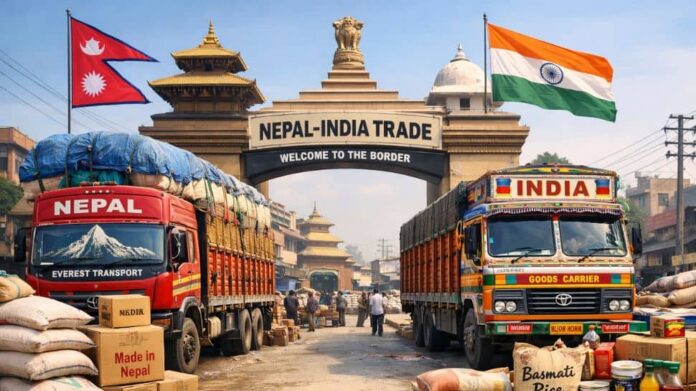
New Delhi: Strengthening business linkages and sustained investment flows between India and Nepal are expected to drive bilateral trade into a new growth phase, with volumes likely to double by 2030, according to an article in Nepalese media.
Bilateral trade remains the most visible and measurable pillar of India–Nepal economic relations, reflecting both geographic proximity and deep-rooted interdependence. India accounts for over 64 per cent of Nepal’s total trade, underscoring its centrality to Nepal’s external economic engagement and supply chains. In FY 2024–25, total bilateral trade reached approximately USD 8.7 billion, reaffirming India’s position as Nepal’s largest trading partner by a wide margin.
India’s exports to Nepal stood at about USD 7.4 billion, dominated by petroleum products, machinery, vehicles, pharmaceuticals, food items, and construction materials, which are critical to Nepal’s consumption and infrastructure needs. Nepal’s exports to India, valued at nearly USD 1.3 billion, mainly include electricity, agricultural products, iron and steel items, and manufactured goods.
Add Zee News as a Preferred Source
This robust trade structure underscores both the extent of economic integration and the significant potential for diversification, value addition, and more balanced growth of Nepal’s export basket in the coming years. With growing business and investments, the trade trajectory is expected to enter a new phase, with bilateral trade doubling over the next five years, according to the article in the Nepal Aaja news portal.
The article also highlights that India–Nepal bilateral investments reflect a deepening economic partnership anchored in geographical proximity, historical trust, and growing strategic convergence. Indian companies constitute the largest source of foreign direct investment in Nepal, accounting for roughly 30–35 per cent of Nepal’s total FDI stock.
Cumulative Indian investment is estimated at USD 750–800 million, with operational investments of nearly USD 670 million spread across more than 150 Indian ventures. These investments span key sectors such as hydropower, manufacturing, banking, insurance, telecommunications, cement, tourism, education, and hospitality, making India a critical driver of Nepal’s industrialisation and services-sector expansion.
Indian public and private enterprises have played a particularly transformative role in Nepal’s hydropower sector by combining capital, technology, and assured power off-take arrangements, thereby strengthening Nepal’s energy security while creating long-term commercial returns for Indian firms. Indian banks and insurance companies have contributed to financial deepening and stability, while joint ventures in manufacturing and tourism have generated employment, skills, and local value addition.
This investment synergy is reinforced by India’s broader development partnership initiatives, which support infrastructure creation, cross-border connectivity, and capacity building, thereby lowering investment risks and enhancing economic integration. Together, investment flows and development finance are knitting the two economies into a closely interconnected economic space with shared long-term interests, the article points out.
Energy cooperation has emerged as a transformative pillar of India–Nepal relations, redefining Nepal’s role in the regional economy. Nepal possesses vast hydropower potential, estimated at over 40,000 MW of economically viable capacity. In recent years, concerted efforts by both governments have enabled Nepal to transition from a net importer of electricity to a growing exporter.
In fiscal year 2024–25, Nepal exported approximately NPR 17–18 billion (about USD 130 million) in electricity, with the majority sold to India. Long-term power trade agreements envisage Nepal exporting up to 10,000 MW of electricity to India over the coming decade.
This energy partnership provides Nepal with a stable source of export revenue while supporting India’s clean energy transition and regional grid stability. The integration of power markets has also positioned India as a transit country for Nepal’s electricity exports to third countries, further enhancing regional economic cooperation, the article added.