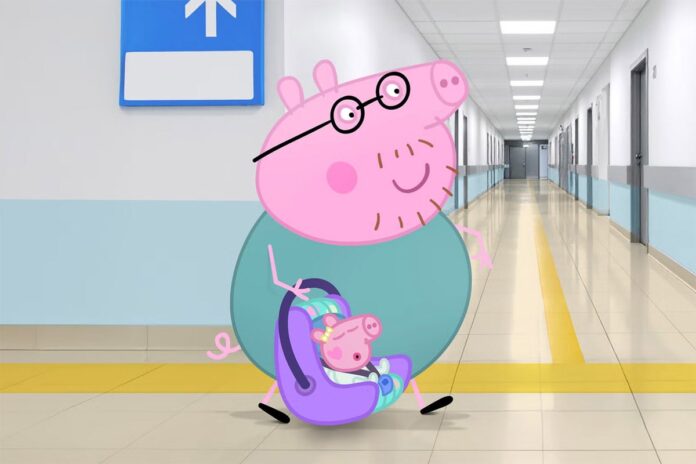
David Gandy has called Peppa Pig’s dad a “useless fool” who promotes a bad “narrative” about men in the same way Andrew Tate does.
The supermodel, 45, who has two children, Matilda, seven, and Tabitha, four, with his barrister partner Stephanie Mendoros, was speaking on BBC’s Laura Kuenssberg on Sunday when he turned his attention to the caring, loving and fun Mr Pig.
“From a man’s point of view,” he said, “why are my children reading this book and the dad is a useless fool?”
Gandy, who is calling for better role models in popular culture where men are often portrayed as either wimpy or excessively masculine, also claims that Daddy Pig sets a bad example to children about gender roles.
Whether it’s Daddy Pig reading maps upside down or getting stuck in a soft play tunnel rescuing Mummy Pig, the basic complaint – according to Gandy – is that Mr Pig is so incompetent, he can’t share the parenting workload.
This isn’t even the first time that Gandy has criticised Daddy Pig. Last month, the model labelled him “a bungling fool who gets it wrong, while the mum gets everything right,” when he contributed to the Centre for Social Justice’s (CSJ) think-tank’s Lost Boys study. Clearly, Daddy Pig has got under his skin.
Gandy is one of the UK’s best-paid male models, best-known for wearing white briefs in Dolce and Gabbana’s 2007 Light Blue advert, and believes men of his generation are taking on a “different role”, which needs to be better represented in film and TV.
“I do the washing, I do the cleaning, I do the school run,” he told the BBC. “Our roles have changed; we are the first generation my age where we’re seeing the dads who have to take on a different role.”
Gandy, along with the CSJ, is calling for a “masculinity reset” to address the unhealthy portrayal of men as either “frightening or pathetic”, saying: “There are not enough good examples out there of good, kind men and the things they do.”
Clearly, he hasn’t watched enough Peppa Pig.
In Peppa Pig, which first appeared on our TV screens in 2004 and is now the most-watched YouTube channel on television in the UK, Daddy Pig might be clumsy, but at his core, he’s a good, decent dad. I should know – I watched him for seven years with my daughters.
Daddy Pig is emotionally present for his kids, which, let’s face it, is a miracle when parents like myself struggle to stop scrolling on our phones, even when we should be engaging with our children.
He balances fun and responsibility and rarely gets angry, showing endless patience – even pretending to like ketchup-flavoured cake when Peppa and George make it for him for Father’s Day. Most importantly, he supports his kids’ dreams, such as Peppa’s wish to become a puddle jumping champion one day.
When I asked my children – Lola, nine and Liberty, seven – if they thought all dads were silly because Daddy Pig is, they said: “No, of course not”.
The Pig family is just one family, and kids know it’s not representative of all family dynamics, including their own. Like my children, they see a whole range of dads among their friends, from hands-on types, to workaholics and absent dads. The great misconception is that one buffoon-like dad on TV means a generation of kids will turn out like Daddy Pig, or marry one.
I’m not saying Peppa Pig isn’t highly influential. When Lola was three I had to take her to the GP because she developed a snort. I was terrified she had breathing issues, but it turned out there was nothing medically wrong with her – she was just copying the entire Pig Family. But that doesn’t mean she believes all families need a Daddy Pig to laugh at.
My kids don’t have a dad, and watching shows like Peppa Pig makes them long for one. Not only is Daddy Pig always in a good mood, but he’s kind. It’s so important for my children to see a kind, male figure – even if he is a pig.
We simply can’t take everything out on Daddy Pig or blame everything on the “Peppa Effect” – which has been happening for years.
The reality is my kids don’t have a dad, and watching shows like Peppa Pig makes them long for one. Not only is he always in a good mood, but he’s kind.”
Last year, parents in the US accused Peppa of turning their children into “spoilt brats” because she’s “rude” and “impatient”. Others were more upset by the fact that their children had picked up Peppa’s British accent, with their American children calling “gas stations “petrol stations”, and pronouncing tomato “to-mah-to”, not “to-may-to”.
The show has been accused of body-shaming, with Peppa labelled a “body-shaming bully” for making fun of Daddy Pig’s big “tummy”. In 2024, Spanish politician Marta Serrano even blamed Peppa Pig for the lack of women in the construction industry, saying the show is “teaching girls that the road sector is not for them and is a man’s thing.”
In 2017, Dr Catherine Bell, a GP, wrote an amusing piece for the British Medical Journal criticising the show for fostering unrealistic expectations of family doctors, with Dr Brown Bear doing unnecessary prescribing, inappropriate home visits, being available 24/7, and having a disregard for confidentiality and parental consent.
Worse is poor little George Pig, who is always excluded from his sister’s games when she’s got a friend over, which mums fear might teach their kids unacceptable behaviour.
Basically, Peppa Pig can’t win. As parents, we’re advised to switch to shows like Bluey, Bing Bing and Hey Duggee instead. While Keira Knightley said having to watch Peppa Pig for seven years put her off having a third baby.
But we can’t blame all society’s woes on Peppa – or Daddy Pig. As parents, we must take responsibility for our own behaviour. and that of our children.
Let’s get it in perspective. Peppa Dad is a pig with glasses – and this cartoon for toddlers is huge fun. It can’t be taken as seriously as self-proclaimed misogynist Andrew Tate.
My children no longer watch Peppa Pig , but it was part of their childhood, like it is for every other family I know. We went to the musical show, and they wanted Peppa Pig wellies. Then they went off it, just like that. Neither of them have been left scarred by Daddy Pig’s trail of mishaps.
The truth is, Daddy Pig might be useless, but he’s not giving dads a bad name. He’s not one-dimensional and being laugh-out-loud “silly” is just one of a long list of his good qualities. As young men have a crisis of identity, I can think of far worse influences than Daddy Pig.